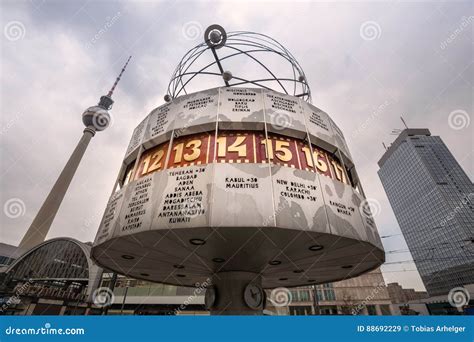
In the late summer of 1969, shortly before the 20th anniversary of the DDR, there was hectic activity on Alexanderplatz square. The big celebrations were to take place here on 7 October 1969, but the open spaces between the new buildings still looked like a construction site. Even the DDR press reported on 30 August 1969 about delays in the plan, which rarely happened: »The last thousand square metres of white concrete to be applied are still causing concern. Subsequent cable laying and a lack of white cement have held up the completion of this work. However, the installation of the World Time Clock has not resulted in any complications between structural and civil engineering.«
But if there was one thing that worked in the DDR, it was rushed actions. The party leadership mobilised student brigades and even the military. Work was even done at night under the spotlight. By the beginning of October, all the cables were under the ground, the paving slabs were laid and the raised beds were planted with pansies. On 3 October 1969, the World Time Clock started moving.
All the time in the world
Originally also called the &r
Urania world time clock at Alexanderplatz
Legend says:
"If lovers standing next to the world clock and hold hand at 0.00 a.m., they will stay together forever."
Another reason to have a closer look at the world clock: The world clock on Alexanderplatz is a popular meeting place for Berlin residence as well as tourists. It stands 10 meters high and weighs about 16 tons.
But why is this clock called "Urania World Clock"? An Urania column was found in 1966 during demolition work on Alexanderplatz. It was an old street clock with built-in weather station - which was built by the former clock factory "Urania".
In 1969, the world clock was designed by Erich John and erected by the former GDR. The world clock represents a stone mosaic - which looks like a compass rose. In each of the 24 segments are different countries shown and 148 cities listed presenting the respective time zone. An hour ring rotates through these time zones displaying the current time in the places around the world. Above the world clock is the solar system presenting the various planets.
In 1997 the clock has been completely refurbished, all city names have been updated and many other cities
URANIA WORLD CLOCK ALEXANDERPLATZ
The Urania World Clock is a magnificent astronomical clock located in Vienna, Austria. It was built between 1898 and 1908 by the Austrian watchmaker brothers Franz and Jakob Deutsch. The clock is housed in the Urania observatory building and features a variety of dials and mechanisms that display the time, date, and positions of celestial bodies. The design of the Urania World Clock is a stunning example of Art Nouveau style, with intricate ornamentation and detailed craftsmanship. The clock face has a beautiful blue and gold color scheme, with decorative elements such as stars, planets, and zodiac signs. Visitors to the Urania World Clock can marvel at its intricate inner workings and watch as the various hands and dials move in perfect synchronization. It is a true masterpiece of both art and engineering, and a must-see for anyone interested in the intersection of science and aesthetics.
Discover the Fascinating World Clock on Alexanderplatz
What is the World Clock on Alexanderplatz?
It is very accepted attraction located in Alexanderplatz in Berlin, Germany as people can watch world clock, which is a big attraction nowadays. It is an amazing structure of digital clock that shows age in various global cities signifying that Berlin i s a world city.
History and Design
The construction of the World Clock was initiated in 1969 with an aim giving a glimpse of what the 20th anniversary if the German Democratic Republic would look like. It was constructed by an architect, Erich John with apparent inclination towards latest structure. This was a contrivance made up of a immense drum onto which were marked the names of 148 head cities of the world. Every city has a metal plate with the city’s name on it and the current second shown on a dial.
Its construction is similar to a clock tower, has the height of 10 meters (33 feet) and a weight of about 16 tons. Due to its manufacturing materials of steel and aluminum, it remains rigid even up to this year. The Society Clock looks like a complicated piece of engineering that can impress with the skills of its designers.
How
World Clock in Berlin (Weltzeituhr)
One of the most important landmarks gracing Alexanderplatz is the Berlin World Clock, the epitome of freedom and peace throughout the world, and the most popular meeting place in the capital. On 9 November 1989, when the Berlin Wall (Berliner Mauer) fell, Berliners and tourists alike saw the World Clock for the first time. They displayed the time of all time zones and major cities in the world simultaneously and also had the inscription "Time will destroy all walls" (Die Zeit wird alle Mauern niederreißen). This clock, along with the fallen Berlin Wall, has become a symbol of a new era, freedom, peace and unity.
The unique chronometer is a 10-metre-high column with a cylindrical dial. At the top of the structure are rings with spheres — symbols of planets moving in orbits. On the pavement around the base of the column is a mosaic of the "Rose of the Winds".
History of emergence
The opening ceremony of the clock took place on 30 September 1969. The same year, the Berlin TV Tower (Berliner Fernsehturm) appeared on Alexanderplatz to mark the 20th anniversary of the founding of the GDR, which was celebrated on 7 October. East Berlin Square,